A new choice for efficient palletizing! These robots are accurate and fast, helping you improve production efficiency. In today's highly competitive manufacturing sector, improving production efficiency has become the key to the survival and development of enterprises. As palletizing is an important link in the production process, improving its efficiency is crucial to the operation of the entire production line. Nowadays, the emergence of robot palletizing technology provides enterprises with efficient and accurate new options and has become a powerful weapon to improve production efficiency.
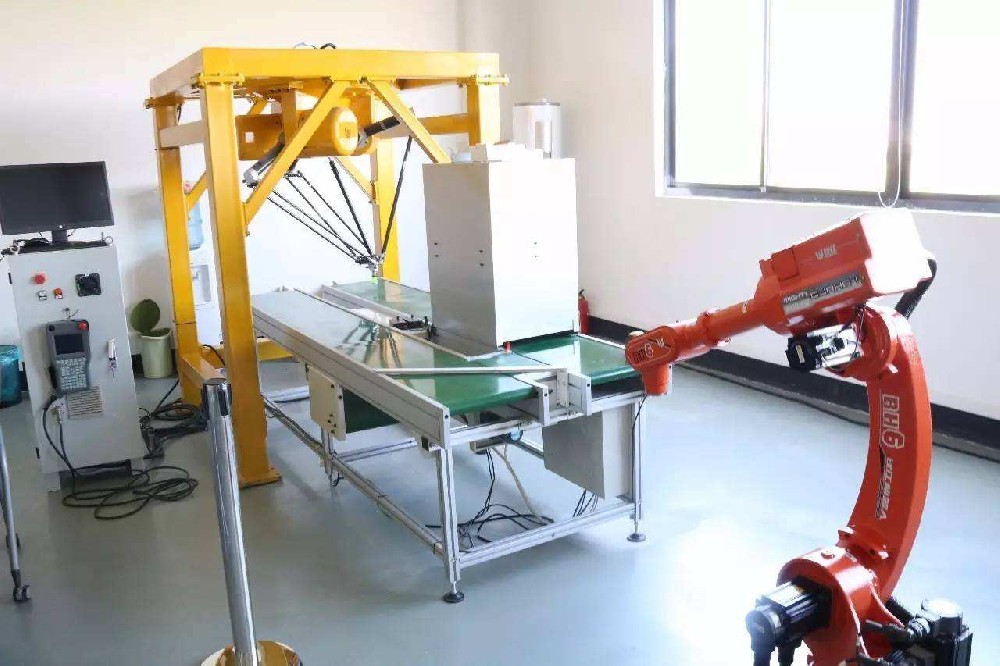
Traditional palletizing methods often rely on manual operations, which are not only inefficient but also prone to errors and fatigue. Robot palletizing can overcome these problems and achieve efficient and accurate palletizing operations. The robot has high-speed, high-precision motion control capabilities and can grab and place goods quickly and accurately, greatly improving the speed and quality of palletizing. Compared with manual palletizing, robot palletizing can work continuously, is not affected by fatigue and emotions, and can maintain a stable working state, thus improving production efficiency and product quality.
These robots are usually equipped with advanced sensors and vision systems that can sense the location, shape, and size of goods in real time, and perform precise grabbing and placement operations based on this information. Through the guidance of the vision system, the robot can accurately identify the stacking position and direction of goods, avoid misplacement and overlap of goods, and improve the neatness and stability of palletizing. The robot can also be flexibly programmed and adjusted according to production needs, adapting to different types and specifications of cargo palletizing requirements, and has strong versatility and adaptability.
In practical applications, the robotic palletizing system can be seamlessly integrated with other equipment on the production line to achieve automated production processes. For example, robots can be used in conjunction with conveyors, sorters and other equipment to realize automatic transportation, sorting and palletizing of goods, reducing manual operations and improving production efficiency and automation. The robot palletizing system can also interact with the company's production management system to realize real-time monitoring and analysis of production data, providing strong support for the company's production decisions.
In addition to improving production efficiency, robotic palletizing has many other advantages. For example, robot palletizing can reduce manual labor intensity and reduce labor costs. In some dangerous and harsh working environments, such as high temperature, high pressure, toxic environments, etc., robots can replace manual labor to ensure the safety and health of workers. Robot palletizing can also improve the space utilization of the warehouse, reduce the floor space of goods, and facilitate the storage and management of goods.
To achieve efficient robot palletizing, companies also need to invest and optimize in many aspects. Enterprises need to choose a robot palletizing system that suits their own production needs, including selection of robot models, specifications, performance, etc. Enterprises need to properly program and debug robots to ensure that the robots can accurately perform palletizing tasks. Companies also need to train operators to improve their operation and maintenance capabilities of the robot palletizing system to ensure the normal operation of the system.
As an efficient and accurate palletizing method, robot palletizing provides a new option for enterprises to improve production efficiency. Through the application of robot palletizing systems, companies can realize automated production processes, improve production efficiency and product quality, reduce labor costs and safety risks, and enhance the competitiveness of companies. In the future development of the manufacturing industry, robot palletizing technology will play an increasingly important role and become an important means for enterprises to improve production efficiency.